Praying Mantis Totem
The praying mantis teaches us to sit in stillness so we can act with precision and right timing, see from a new angle, release what is old, and reconnect with intuition and inner wisdom. It is a totem of quiet attention, concentration, and listening before action.
The praying mantis teaches us to sit in stillness so that we can act with precision and at the right time, to look from a new angle, to let go of the old and grow, and to reconnect with intuition and inner wisdom. As a totem, the praying mantis speaks of our ability to enter a state of calm, concentration, and observation, and to remain in quiet listening before we act, knowing that our deepest power arises there.
Precise timing through conscious action
There are thousands of mantis species in the world. In Israel, more than twenty species are known, living in almost every habitat and able to survive in demanding conditions, from the ground to the tops of plants. Among them, the green praying mantis is one of the best-known species.
It is a large, ancient, and common insect, active mostly in summer and in heat. It seeks shade and is sometimes active at night, especially males looking for females.
The female mates once in her lifetime, as one male provides enough sperm for all her eggs, and she lays several egg cases. The mantis can endure hunger by conserving movement, but it is sensitive to cold. Males live only a few weeks; females can live up to a year.
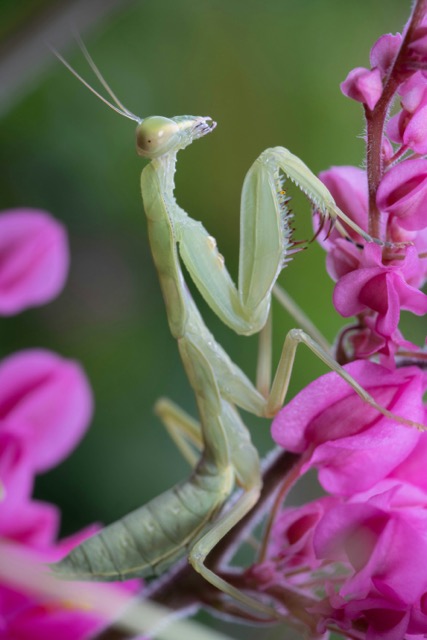
Its body is divided into head, thorax, and abdomen. The thorax is narrow and elongated, with three pairs of legs. The front pair became powerful hunting legs, about a third of the body length, able to seize prey in around 30 milliseconds. Their structure allows the mantis to grip insects and sometimes even lizards, geckos, and in rare cases very small birds, though its usual food is small insects such as flies and bees. Its flexible forebody also expands its field of vision.
The praying mantis has remarkable eyesight. Its large compound eyes and broad triangular head are essential for ambush hunting. Each eye contains about 9,000 facets, creating a wide field of vision and overlapping focus that gives it binocular sight and an accurate sense of distance. Prey approaching at a certain angle enters its striking range.
Its attack is so fast that it can catch a fly in midair. For longer distances it makes peering movements, and on its forehead are three simple eyes sensitive to changes in light intensity, helping it sense passing time and detect motion through shifting shadows.
Vision is highly developed in the mantis, while smell is less central. Its long, threadlike antennae help it probe the surroundings and detect obstacles or prey.
For example, when it identifies prey, it becomes alert. If the prey is too far away, it approaches slowly and cautiously. Only when it reaches the right range does it move with sudden speed and seize the prey with one or both legs in a powerful grip.
As a totem, it teaches action that comes from inner knowing, not from pressure or haste. It guides us to examine situations deeply, not to rush, and to choose our words, actions, and timing with care and precision.
Praying mantises are also masters of camouflage. Some resemble leaves, sticks, flowers, or even butterflies. Their color can shift to match the environment and light conditions. In stronger light they may appear brown; in weaker light, green. This change happens only between molts and is especially important for wingless nymphs.
Mantises are often described as cannibals, especially in early growth stages, and there is a famous myth that the female eats the male during mating. In practice, this is much rarer than people imagine.
Attention and concentration — the melody of silence
The praying mantis is known for its ability to remain completely still and deeply focused while waiting for prey, sometimes for hours.
In this way it teaches the importance of inner and outer attention, the ability to concentrate on one aim and not be pulled away by distraction.
It reminds us that quiet observation and focused presence can lead to deep understanding and effective action.
When we encounter a praying mantis, it is good to pause and ask whether we, too, need to stop, quiet the outer noise, and listen to the inner voice. When we pause and settle our thoughts in order to look inward, we may discover strengths and capacities that were not accessible to us before.
There is immense power in silence. We can meet ourselves there, in stillness and presence, through meditation, dreaming, or any experience of inward quiet.
As a totem, the praying mantis teaches the art of silent waiting, because this is part of how it survives. Ted Andrews writes in Animal-Speak that the mantis teaches us to quiet what is outside us, so that when it is time to act, in any area of life, we can do so with confidence, precision, and great force. Silence can be used in many ways — for creation and for healing.
There is a folk saying that we have one mouth and two ears so that we may listen twice as much as we speak.
The praying mantis often appears in times of excess outer or inner noise. Its medicine is our ability to sit quietly, slow down, refrain from speaking too soon, remain in silence and patience, and in this way become able to hear the deeper music of life.
The green mantis spends most of its time on plants, patiently waiting for prey. It blends into its surroundings through slow movement. While hunting, it often resembles a twig and sways gently as it moves through the branches, as if stirred by the wind.
Sometimes the hunt fails, yet the predator continues trying.
The praying mantis eats its prey while it is still alive, without hesitation, beginning with the most accessible part and often consuming all of it, sometimes leaving only wings. After eating, it carefully cleans its limbs and eyes of food remains and dirt, an essential act for preserving its senses and hunting ability.
A new perspective
The praying mantis can turn its head almost 180 degrees to follow prey or watch for danger without moving its body at all. As a totem, it symbolizes the ability to see things from more than one angle.
One of the most healing and strengthening things we can do is adopt a different point of view — higher, wider, or more hopeful. This can reveal new insights and help us break old patterns.
An encounter with the praying mantis reminds us to widen consciousness and be willing to see things from an unusual angle. In this way, perspective itself can change. It is worth remembering that the highest perspective is also the widest.
There is a teaching from Rabbi Chaim of Volozhin, one of the great students of the Vilna Gaon, that speaks of a powerful way to meet hardship: to pause and focus on the truth that there is no power apart from the Divine.
In times of distress or challenge, we can stop and widen our perspective by turning our attention to the presence of the Creator, to the sense that all of creation is held within a wise and benevolent source.
He teaches that deeply holding this truth can transform a person’s inner reality and loosen the grip of fear and hardship.
“It is truly a great matter and a wondrous remedy to remove and nullify from oneself all harsh judgments and other wills, so that they cannot rule over a person or leave any mark at all — when a person fixes in the heart the truth that the Divine alone is the true power, and there is nothing apart from That… and binds the purity of thought only to the One Master, then all other forces and wills lose their hold.”
— Nefesh HaChaim, Gate 3, Chapter 12
Connection to intuition and inner wisdom
The praying mantis totem reminds us to listen to intuition, dreams, and the inner voice. It symbolizes connection with the world of spirit, with inspiration, and with creative insight.
This totem may appear in moments of confusion, reminding us that the answer is already within us.
The mantis has what is sometimes called a “cyclopean ear” in its thorax — an ear especially sensitive to high ultrasound. This is considered an advanced trait associated with flight, appearing mainly in males and in flying species. In the past, researchers assumed this sense evolved mainly to protect mantises from bats, since during night flight their response to ultrasound is often to drop or change direction. Research suggests the hearing may be more ancient, and perhaps connected to other predators as well. In some species there is also another ear sensitive to lower frequencies, though its role is still unclear. Some species, including the green praying mantis, can also produce low-frequency warning sounds by rubbing their wings, though their origin and function are still being studied.
As a totem, the praying mantis reminds us of our own capacity for deep listening — to intuition and to the inner signals that know how to guide us toward the right path.
Growth and releasing the old
The praying mantis undergoes incomplete metamorphosis. It sheds its skin and renews itself again and again. Insects of this kind develop through three stages: egg, then nymph — which resembles the adult but is smaller and wingless — and finally adulthood. The nymph grows into its mature form through repeated molts, unlike insects that pass through a cocoon stage.
The praying mantis goes through repeated transformations and sheds its skin. This symbolizes the importance of leaving behind what no longer serves us in spiritual growth — old inner blocks, old patterns, and what has become too narrow for the life that now wants to emerge.
Among some African tribal cultures, including Khoi and San traditions, the praying mantis has been seen as a sacred being and at times as a manifestation of higher powers. In some San traditions, a shape-shifting figure is described in the form of a mantis.
In Chinese and Japanese culture, the mantis has inspired martial arts, and movements resembling it appear in certain martial traditions.
In Christian tradition and Western mysticism, because of its prayer-like posture, it has sometimes been regarded as a symbol of prayer, connection with the Divine, and spiritual awareness.