Kingfisher Totem
The kingfisher represents precision, inner sight, and balance between elements. It teaches us to see through illusion, stay inwardly steady even in stormy times, and discover that our true light and strength arise from the inner structure of the soul.
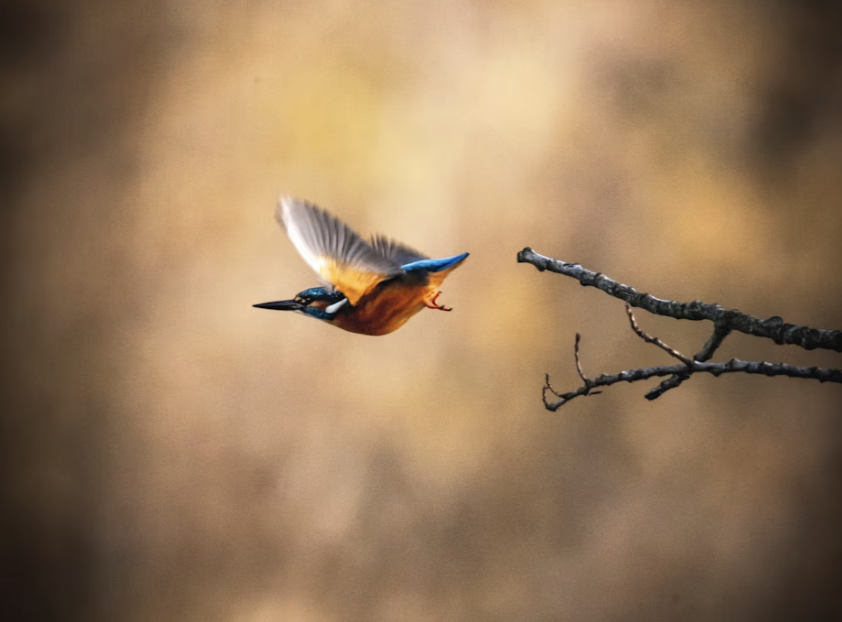
The kingfisher as a totem of precision, inner vision, and balance between elements
The kingfisher teaches precision, sight that pierces illusion, inner steadiness in the midst of upheaval, and the understanding that our true light and power arise from the inner structure of the soul.
The kingfisher is a striking bird family that includes about 114 species, grouped into three main subfamilies: river kingfishers, tree kingfishers, and water kingfishers. In Israel there are three species, each belonging to a different subfamily: the common kingfisher, the pied kingfisher, and the white-throated kingfisher. Most kingfishers around the world—especially the tree kingfishers, which include the Australian kookaburra—live in tropical forests and feed on insects, small reptiles, frogs, and even rodents. In Israel too, the white-throated kingfisher spends much of its time in open fields and along roadsides, hunting arthropods.
Because of its beauty, vivid colors, and remarkable qualities, many cultures saw the appearance of a kingfisher as a sign of good fortune and approaching abundance. In Polynesian and Maori tradition in New Zealand it was considered a sacred bird, and in early Christian symbolism it represented spiritual renewal, purity, and eternal life.
Precision and steadiness
The kingfisher hunts from what appears to be a passive place of waiting. It sits motionless on a branch above the water, reads the refraction of light, and waits for the exact moment when its prey becomes vulnerable. The kingfisher totem reminds us that we do not always need exhausting, constant effort. Sometimes it is wiser to wait patiently while staying focused on the goal, so that in the decisive moment we can gather all our energy into one precise, swift, determined action.
An encounter with the kingfisher teaches that focus is often more powerful than strain. It teaches timing, and reminds us of our ability to bring ideas into reality smoothly and accurately.
When there is no branch, reed, or elevated perch above the water, the kingfisher can hover in one fixed point in the air while beating its wings extremely rapidly in order to scan the water for fish. In scientific terms, hovering is one of the most mechanically and energetically demanding forms of flight in nature.
To remain suspended in one place without moving forward, the kingfisher changes the angle of its wings and moves them in an almost horizontal path, generating lift both on the forward and backward stroke.
All the while, its head remains almost perfectly still in space as the body and wings move powerfully around it. In this way the kingfisher keeps flawless focus on the fish swimming below despite the wind. This stabilization relies on a remarkable biological mechanism that allows animals to lock the gaze and head onto a fixed point even while the body is in constant motion.
Thanks to this steadiness, the kingfisher is an extraordinarily effective hunter. Its brain combines two sensory systems at once: the eyes register background movement and compensate for it to prevent blur, while the organs of balance in the inner ear detect every tiny shift of the body caused by wind or wing movement. Together, these systems send immediate microscopic corrections to the neck muscles. The result is astonishing: the whole body vibrates and moves intensely, while the head stays level and stable in space.
Unlike humans, who can move the eyeball freely within the socket, most birds—especially hunters—have relatively fixed eyes. They cannot simply roll their eyes to track a fish. To compensate, evolution gave them a highly flexible neck with more vertebrae than mammals, allowing them to focus vision by moving the entire head.
If the kingfisher’s head moved even slightly during hovering, its viewing angle would constantly shift, the calculation of light refraction would be disrupted, and it would miss the fish entirely. This stabilization gives it almost laser-like accuracy. That is why it can plunge into the water at great speed and catch its prey with astonishing precision.
In Jewish spiritual thought and in Hasidic teaching, steadiness is closely linked with devekut—inner cleaving, or living in conscious attachment to the Divine. The world can be turbulent, distracting, and changeable. The work is not necessarily to quiet the whole world, but to keep the “head”—our inner consciousness—steady and directed toward what is deepest and most true.
The kingfisher’s steadiness does not come from a quiet environment, but from an inner center of gravity that cannot easily be shaken.
When we anchor ourselves in the Divine, in the Creator, in the Great Spirit, in the source of goodness itself, what reaches us no longer has to scatter us. It can be gathered into focus, steadiness, and trust.
The kingfisher is also considered one of nature’s most efficient hunters because of the shape of its beak. When it dives from air into water, it overcomes the sudden change in resistance—from low-pressure air to high-pressure water—thanks to the aerodynamic structure of its bill. It enters the water with minimal loss of energy and hardly any splash. Its entry is so smooth that it creates almost no disturbance, something essential for a hunter that needs silence at the moment of impact.
This natural design inspired the redesign of the nose of Japan’s high-speed train. Engineer Eiji Nakatsu, who was also a birdwatcher, realized that the kingfisher’s beak allows it to pass from air to water with almost no sound or shockwave because it cuts through both so cleanly. He used that insight to solve the loud sonic boom created when trains exited tunnels at high speed. After redesigning the train nose in the image of the kingfisher’s beak, the noise was dramatically reduced, air resistance dropped, energy use improved, and the train became even faster.
Seeing beyond illusion
To hunt successfully, the kingfisher must overcome the refraction of light in water and see the fish where it truly is, not where the water makes it appear to be. For this reason, it has also become a symbol of perception that penetrates illusion.
The kingfisher must overcome an optical illusion: light bends in the water and misleads the eye. The fish seems to be in one place while physically it is in another. The kingfisher totem therefore symbolizes the ability to see through appearances and recognize what is true.
The biological wonder that allows this lies in its unusual visual system. The kingfisher has two areas of sharp focus in each eye, unlike the single focal system found in most animals. One serves precise three-dimensional vision in the air. But the moment it enters the water, a transparent membrane closes over the eye and functions like a built-in contact lens.
This changes the way light is focused, and the kingfisher immediately shifts to its second visual focal system, perfectly adapted for sharp underwater sight. This double vision allows it to perceive clearly in two entirely different worlds.
In many spiritual teachings, steadiness and devoted inner focus are what make this kind of sight possible. Material life can mislead us, presenting separation, lack, or fixed limitation as if they were absolute. We look at our lives and may see only difficulty, and from that view grow sad or discouraged, without remembering how quickly reality can turn. Faith and trust can give us a sight like the kingfisher’s—one that looks through the surface distortion and recognizes the living spiritual presence moving within reality at every moment.
The kingfisher teaches that true steadiness is not the avoidance of movement. It is the ability to move, dive, and act within the world while the inner axis remains connected to one stable source.
Lack can be like the water that deceives the eye, but inner vision sees beyond it. In Hasidic thought, times of want and challenge can become places where trust and faith are strengthened. The point is not to wear ourselves down trying to force our way out of difficulty, but to keep turning toward the good, to draw encouragement, and to become inwardly stronger.
Balance between elements
One of the kingfisher’s central qualities is its ability to move with complete speed between two opposite elements: air, which represents thought, higher awareness, and intellect; and water, which represents emotion, the subconscious, and hidden realms. The kingfisher is therefore a powerful bridge between these worlds.
Its energetic teaching is how to feel and express emotion clearly and in balance—without being swept away and drowning in it, and without retreating into an isolated tower of thought. The kingfisher can dive into deep, turbulent water and emerge again with what it came for.
The kingfisher totem comes to guide us in making a conscious dive into the depths of feeling—to agree to feel—gather something of value from there, and return to the space of clear thought.
This totem reminds us that even if we have reached painful or low places in life, it may be precisely there that new wisdom, hidden resources, and real development become available to us. Looking back on past crises, we often see how much value they eventually brought, even if that could only be understood in hindsight.
In his book Animal-Speak, Ted Andrews writes that the kingfisher symbolizes the development of spiritual sight and intuitive abilities through the element of water. In that sense, an encounter with the kingfisher may also be an invitation to examine our relationship with flowing water, which can bring balance to our energy and inner field.
To make such deep dives at high speed, nature equipped the kingfisher with extraordinary protection. When it dives from air into water, it can reach around 40 km/h. Hitting the water at that speed creates immense deceleration force—enough to injure an ordinary bird. To withstand the impact, the kingfisher’s skull includes special air spaces and unusually strong neck muscles that act as shock absorbers, protecting its brain and eyes at the moment of contact.
This quality of steadiness is echoed in the Greek myth that gave the common kingfisher its scientific name, Alcedo atthis. The myth tells of Ceyx, who drowned in a storm at sea, and of his wife Alcyone, daughter of the wind king, who threw herself into the waters after him. Moved by the intensity of their love, the gods saved them, gave them wings, and transformed them into the first kingfishers. Each year, for two weeks around the shortest day of the year, the sea is said to grow calm so Alcyone can lay her eggs in a floating nest. These became known as the Halcyon Days—a symbol of calm, peace, and inner stillness in the heart of upheaval.
The kingfisher totem symbolizes the capacity to develop a kind of resilience in storms—to find a space of complete inner quiet, allowing peace and a sense of protection even when everything around us, and within us, is turbulent.
An encounter with the kingfisher awakens the ability to create a pocket of stillness in the middle of the storm. It invites us to ask ourselves honestly: Are we acting מתוך emotional scatter and agitation, or from a quiet and precise center? Do we feel safe enough to dive into our emotional depths without fear, let what is there unfold and release, gather new insight from within, and return to the world more whole?
Inner truth
Different kinds of kingfishers carry different shades of symbolic meaning through their colors. The familiar kingfisher is marked by blue and turquoise. In spiritual symbolism, blue is often associated with truth, and with the throat center—the place of communication and self-expression. The kingfisher, known for its sharp, high call that declares its presence without hesitation, invites us to sound our own voice and bring our truth into the world without fear.
Its stunning color also contains a biological secret that carries a deeper teaching. The blue does not come from blue pigment, but from what is known as structural color.
At the microscopic level, the kingfisher’s feathers are built from tiny layers and cells whose base tone is actually brownish-gray. Only when light strikes this hidden, precise architecture do wave interferences cancel the other colors and reflect back that radiant metallic blue.
If the feather is crushed and its structure destroyed, the blue disappears and the feather returns to its dull grayish color.
Through this wonder, the kingfisher teaches that our light and beauty are not an outer coating we put on. They are a direct result of inner structure. Our power and influence do not depend on external manipulation, but on the shaping of consciousness and the preparation of the inner vessel. When we are built rightly and aligned with the light, our truth shines outward on its own.